


All-on-4 vs All-on-6: Which Is Right for You?
All-on-4 or All-on-6: When You Want Fixed Teeth Again
Losing most or all of your teeth affects more than the appearance of your smile. It can make chewing, speaking and everyday activities more difficult, while removable dentures may become unstable over time or simply no longer provide the sense of security some patients want.
That is why modern implant dentistry offers the possibility of restoring an entire dental arch using a relatively small number of dental implants.
All-on-4 and All-on-6 are fixed implant-supported prosthetic solutions in which a full arch of teeth is supported by four or six strategically placed implants, respectively.
The goal is not simply to replace teeth.
The goal is to help patients chew and speak normally again, restore the appearance of their smile and regain the confidence that fixed teeth provide.
At DENTAS Dental & Aesthetic Boutique, treatment is planned individually, because the answer to whether All-on-4, All-on-6 or another implant solution is best is different for every patient.
What Is All-on-4?
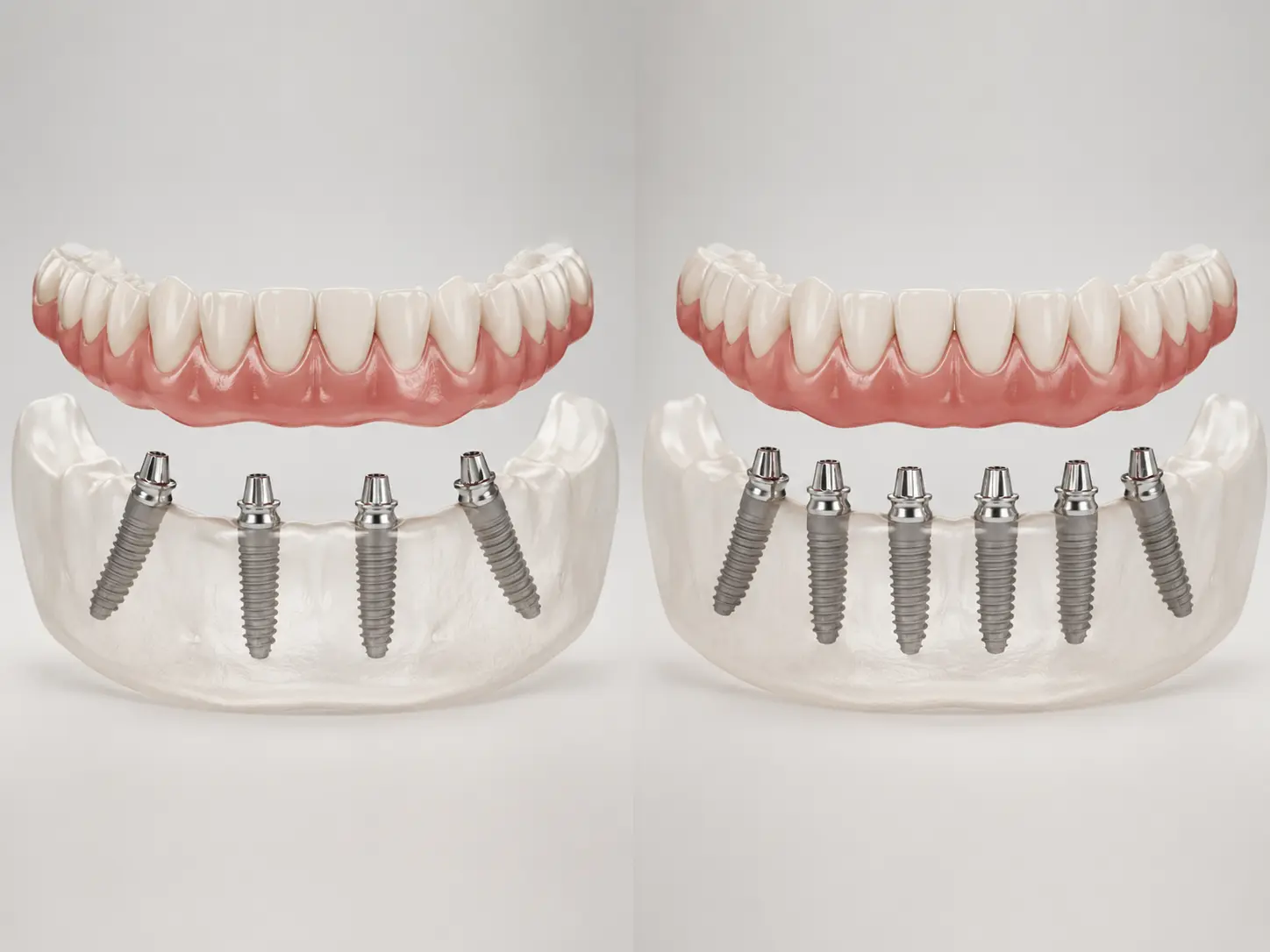
All-on-4 is a full-arch dental reconstruction concept in which a fixed prosthetic restoration is supported by four dental implants.
Typically, two implants are placed in the front of the jaw, while the posterior implants may be positioned at a suitable angle to make the best use of the available bone and provide stable support for the future dental bridge.
In certain cases, this approach can avoid or reduce the need for additional bone augmentation surgery.
All-on-4 is most often considered for people who:
- have no teeth in one or both jaws
- have several teeth that can no longer be preserved in the long term
- have difficulties wearing removable dentures
- want a fixed, more stable prosthetic solution
- have reduced bone volume in certain parts of the jaw.
What Is All-on-6?
All-on-6 follows a similar principle to All-on-4, but the fixed dental bridge is supported by six implants.
Two additional implants provide more points of support, which can be an advantage in certain anatomical and clinical situations.
However, more implants do not automatically mean a better solution.
If the anatomy of the jaw, bone quality and design of the future prosthetic restoration allow for a reliable reconstruction on four implants, All-on-4 may be entirely appropriate.
On the other hand, when conditions allow for the placement of six implants and this arrangement is considered to provide optimal support, All-on-6 may be recommended.
The decision is therefore based not on a preferred number of implants, but on each patient’s anatomy, bone condition, bite, general health and prosthetic treatment plan.
All-on-4 vs All-on-6 – What Is the Difference?
In simple terms:
All-on-4
- 4 implants support a fixed dental arch
- makes use of the available bone
- may reduce the need for bone augmentation in certain cases
- can also be an option for more complex cases of tooth loss.
All-on-6
- 6 implants support a fixed dental arch
- provides additional points of support
- requires suitable anatomical conditions for all implants to be placed
- may be recommended when the bone condition and prosthetic plan allow for this approach.
The key question is not: “Is All-on-4 or All-on-6 better?” but: “Which solution is best for my jaw and my health?”
The answer comes after a detailed examination and diagnostic assessment.
When Is Full-Arch Reconstruction Recommended?
All-on-4 and All-on-6 are primarily intended for patients who are missing all or almost all the teeth in one jaw.
Treatment may also be considered for people who still have their own teeth, but whose teeth are severely compromised due to, for example:
- advanced periodontal disease
- extensive tooth damage
- frequent infections
- loss of supporting tissues
- numerous unsuccessful previous prosthetic treatments.
It is important to emphasise that a tooth with a realistic chance of being preserved successfully in the long term is not removed simply to make way for an implant-supported reconstruction.
At DENTAS, the treatment plan is tailored to the actual condition of each individual patient.
Fixed Teeth on the Same Day
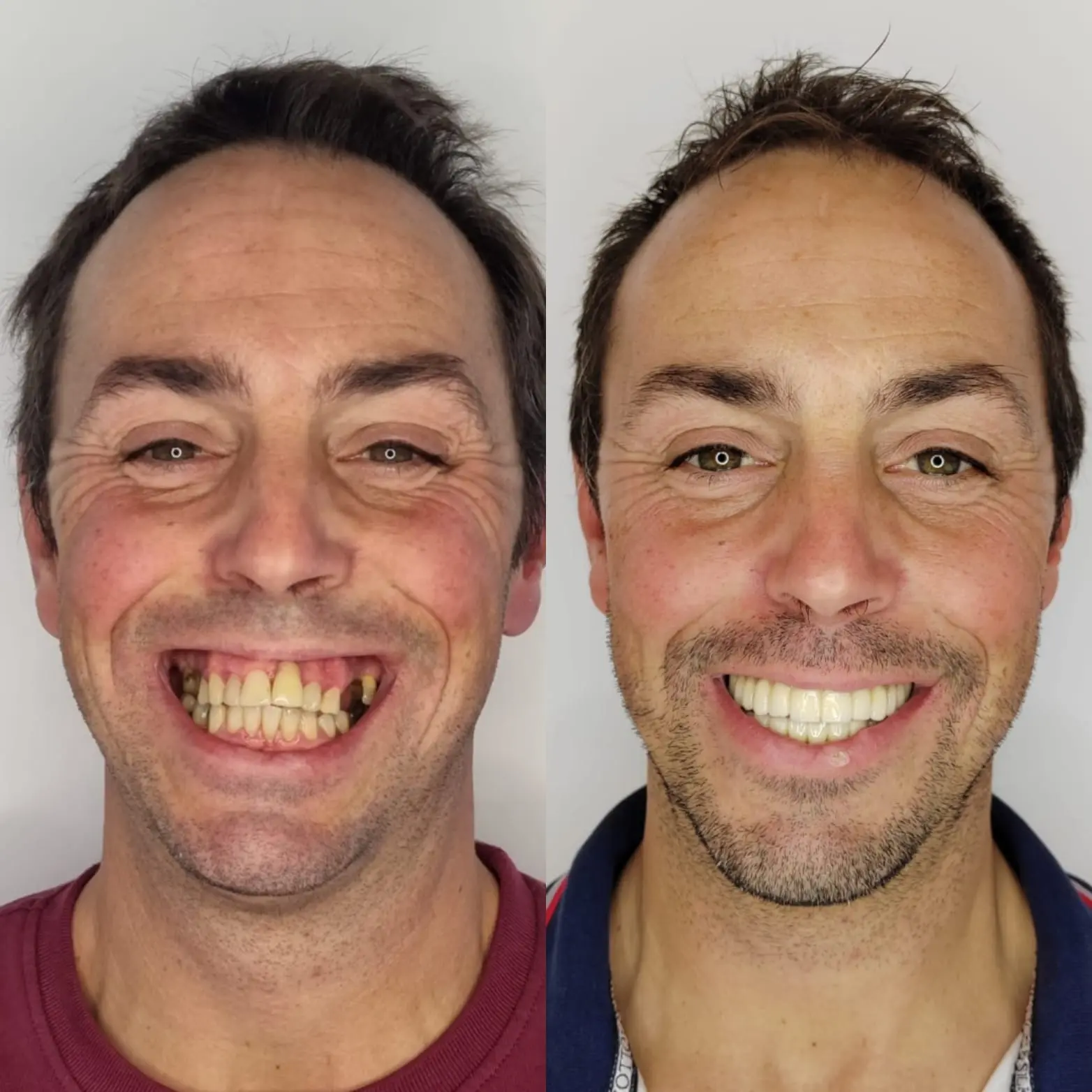
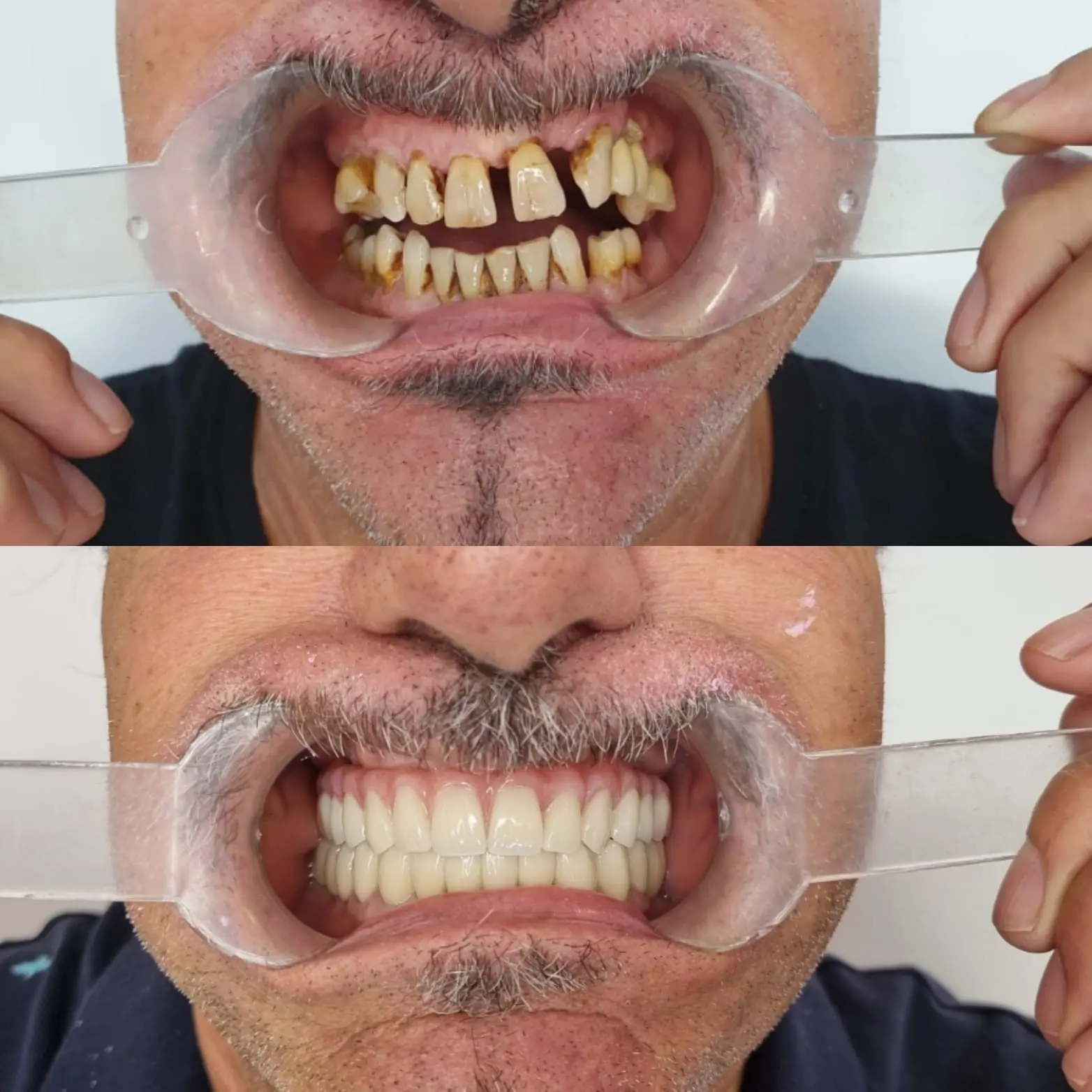
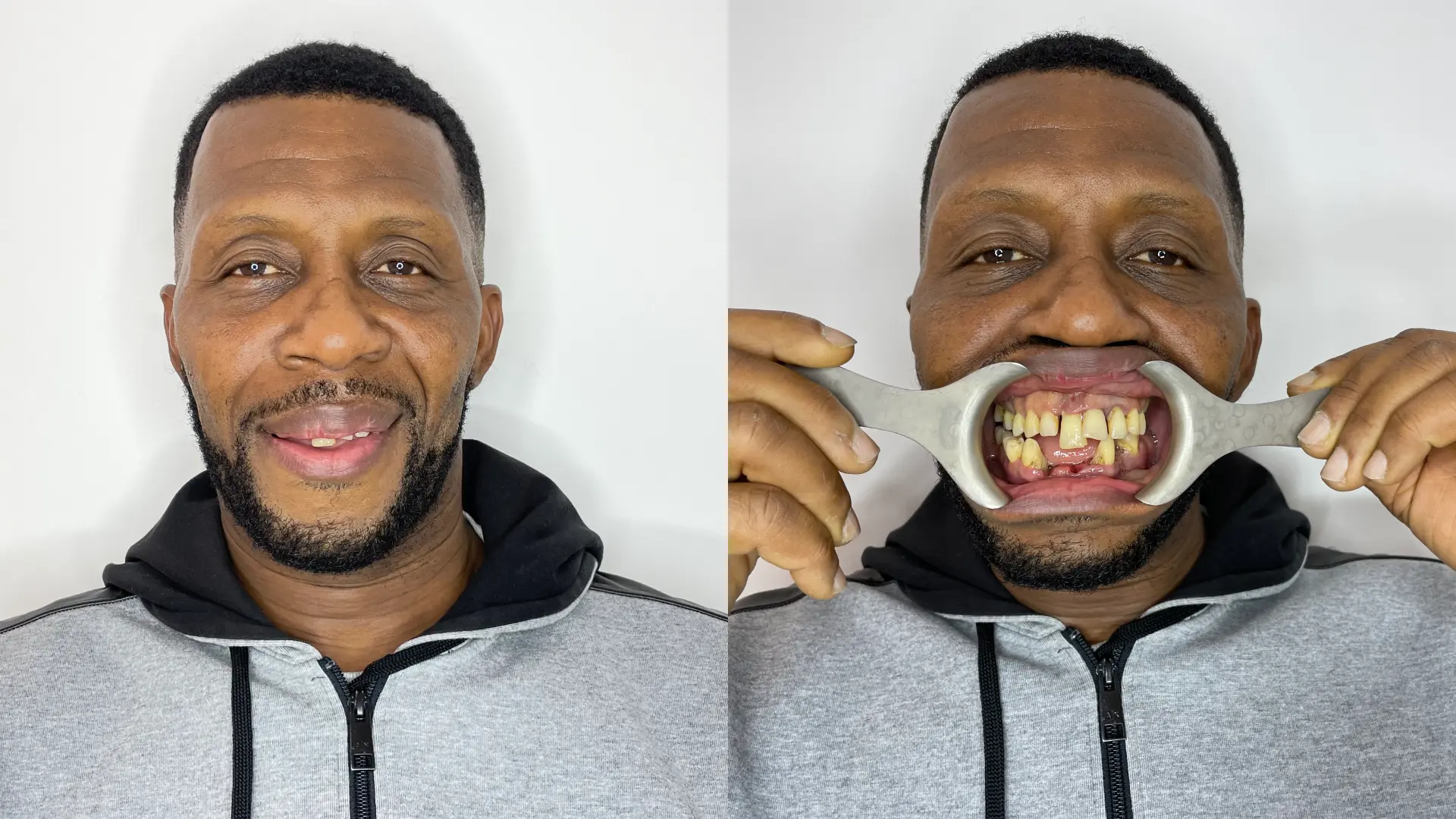
One of the major advantages of All-on-4 and All-on-6 treatment is that patients receive a temporary fixed prosthetic restoration on the same day as implant placement.
This means patients do not leave the practice without teeth. Instead, they receive a temporary fixed solution on the first day of treatment, providing function and an attractive appearance during healing.
The temporary restoration remains in place while the implants integrate with the bone, provided the patient follows the dentist’s instructions regarding diet, hygiene and the load placed on the implants.
Once healing is complete, the final fixed prosthetic restoration is made and individually adapted to the patient’s bite, function and smile aesthetics.
What Does All-on-4 / All-on-6 Treatment Involve?
1. Examination and Diagnostics
Everything begins with a detailed examination.
The condition of any remaining teeth and gums, bone quantity and quality, jaw anatomy, bite and the patient’s general health are assessed.
Based on the diagnostic procedures (dental photography, dental scanning and CBCT) and the information obtained, the position, number and dimensions of the implants are planned.
2. Individual Treatment Plan
After the assessment, the most suitable treatment is determined.
This may be All-on-4, All-on-6 or another implant-supported prosthetic solution.
Before the procedure, patients should understand what will be done, the stages of treatment and what will be expected of them during healing.
3. Surgical Stage and Implant Placement
If any teeth can no longer be preserved, they are extracted according to the treatment plan.
The implants are then precisely positioned in the jawbone.
All-on-4 uses four implants, while All-on-6 uses six implants to support the future fixed dental arch.
4. Temporary Fixed Teeth on the Same Day
After implant placement, the patient receives a temporary fixed prosthetic restoration on the same day.
This immediately restores function and appearance, giving the patient a fixed solution during healing.
During this period, it is especially important to follow the recommendations on diet, oral hygiene and the load placed on the implants.
5. Final Prosthetic Restoration
Once the necessary healing period is complete, the final fixed prosthetic restoration is made.
Function, bite, tooth position and shape are carefully planned, along with the appearance of the smile in relation to the patient’s face.
What Are the Benefits of Fixed Implant-Supported Teeth?
For patients who have worn removable dentures for a long time, one of the biggest changes is often the feeling that their teeth are stable again.
All-on-4 or All-on-6 may provide:
- fixed reconstruction of an entire dental arch
- a temporary fixed restoration on the same day
- greater stability when speaking and chewing
- no movement of the kind associated with removable dentures
- a more natural feeling during everyday activities
- an aesthetically pleasing smile reconstruction
- the possibility of individually designing the replacement teeth
- greater confidence when smiling, talking and eating.
For many patients, regaining a sense of confidence is one of the most important benefits of treatment.
What If I Do Not Have Enough Bone for Implants?
Insufficient bone does not automatically mean that implant treatment is impossible.
With All-on-4, the specific positioning of the implants allows for better use of the existing bone, which in some cases can avoid the need for more extensive bone augmentation.
However, some cases require additional procedures or a different implant treatment approach.
That is why radiological diagnostics are needed before assessing:
- how much bone is available
- its quality
- where implants can be positioned safely
- whether additional bone augmentation is needed
- which treatment approach offers the best conditions for long-term stability.
Is All-on-4 Painful?
Implant placement is carried out under suitable anaesthesia. We also recommend and offer sedation administered by an anaesthesiologist, so the patient should not feel pain during the procedure and is not aware of it.
Swelling, tenderness and discomfort may occur after the procedure and are an expected part of the postoperative period.
The intensity and duration of these symptoms vary from person to person and depend on the extent of the procedure.
After the procedure, the patient receives clear instructions on hygiene, diet and what to do during healing.
How Long Do All-on-4 and All-on-6 Restorations Last?
Dental implants and prosthetic restorations are designed as long-term treatment, but their lifespan cannot be guaranteed in advance.
Many factors influence the long-term outcome:
- bone quality and quantity
- general health
- smoking
- oral hygiene
- the condition of the gums and tissues around the implants
- appropriate loading of the prosthetic restoration
- regular dental check-ups
- professional maintenance of the implants and prosthetic restoration.
In other words, caring for your new teeth does not end when implant treatment is complete. Regular check-ups are an important part of long-term treatment success.
How Do You Care for Fixed Implant-Supported Teeth?
Although dental implants cannot develop tooth decay, the tissues around them must remain healthy.
The areas around the implants and beneath the fixed prosthetic restoration must be cleaned carefully every day using suitable oral hygiene tools.
During check-ups, the dentist monitors the condition of the implants, gums, prosthetic restoration and bite.
Good hygiene is one of the key requirements for maintaining the results of treatment in the long term.
All-on-4 and All-on-6 at DENTAS: Treatment Begins with a Good Plan
When restoring an entire dental arch, the most important thing is not to place as many implants as possible.
What matters most is choosing the right number and position of implants for each patient and carefully planning the final prosthetic result in advance.
At DENTAS Dental & Aesthetic Boutique, our approach to implant treatment is based on thorough diagnostics and individual planning.
Only after an examination is it possible to assess:
- whether the existing teeth can be preserved
- the condition of the jawbone
- whether All-on-4 or All-on-6 is more suitable
- the optimal prosthetic treatment plan
- what final aesthetic and functional outcome can be planned.
If you are missing most or all of your teeth, have difficulties with removable dentures or your remaining teeth are severely compromised, the first step is not to choose between All-on-4 and All-on-6.
The first step is a thorough examination and a good treatment plan.
Book a Consultation at DENTAS Dental & Aesthetic Boutique
During your consultation, we can assess the condition of your teeth and jawbone and explain which fixed implant-supported rehabilitation options are suitable for your individual situation.
Book an appointment to find out whether All-on-4, All-on-6 or another implant solution is the right choice for you.
Frequently Asked Questions About All-on-4 and All-on-6
-
How many implants are used in All-on-4?
All-on-4 uses four dental implants to support a fixed reconstruction of an entire dental arch.
-
How many implants are used in All-on-6?
With All-on-6, the fixed dental arch is supported by six dental implants.
-
Is All-on-6 always better than All-on-4?
No. The optimal number of implants depends on jaw anatomy, bone quantity and quality, bite, general health and the planned prosthetic restoration. The best solution is determined individually.
-
Will I receive fixed teeth on the same day?
Yes. With All-on-4 and All-on-6 treatment at DENTAS, a temporary fixed restoration is fitted on the same day as implant placement. The final prosthetic restoration is made after healing is complete.
-
Can I have All-on-4 if I do not have enough bone?
In certain cases, the positioning of the implants makes it possible to use the available bone and may reduce the need for additional procedures. This can only be assessed after an examination and radiological diagnostics.
-
Is All-on-4 the same as wearing dentures?
No. With All-on-4, the prosthetic restoration is fixed to the implants and cannot be removed by the patient like conventional removable dentures.
-
Can I have All-on-4 in just one jaw?
Yes. Full-arch implant reconstruction can be planned for one jaw or, if necessary, both jaws.
-
How long does the entire treatment take?
A temporary fixed restoration is fitted on the same day as implant placement, while the overall treatment duration depends on the healing phase and fabrication of the final prosthetic restoration. An exact treatment plan is determined individually after the examination.